Tent accessories and ballast
Ballast weights, straps and accessories that keep a tent safe and stable. Essential in wind.
All tent accessories and ballast
Prices are available in the Herva-Doublet Platform.
- Our approach
- 1Concept definition
- 23D design
- 3Production
- 4Installation
- 5Maintenance
What this gives you
From first sketch to maintenance — one partner who coordinates the whole project.
One partner, from A to Z
You call one number. We measure, design, have it produced, install and maintain. No fragmented responsibility, no waiting on subcontractors pointing at each other.
You see it before it exists
A 3D visualisation of your own façade or space, by day and by night. Production only starts once that image is right. No surprises afterwards.
Everything under one roof
From façade to interior: 20 product families with one partner. No need to coordinate three suppliers.
Built to last
ISO 9001 and ISO 14001. Colourfast, weather-resistant materials and energy-efficient LED lighting. With long-term service and maintenance.
Tent accessories and ballast that keep your tent in place
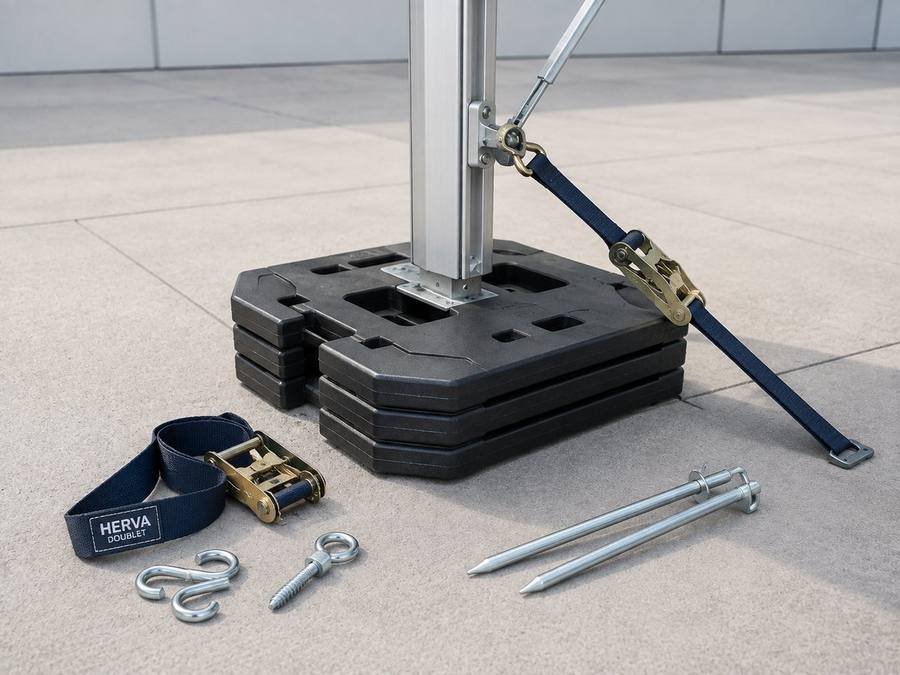
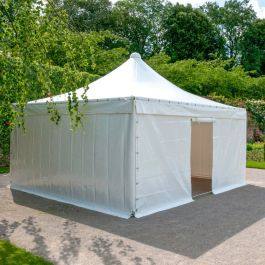
Tent accessories and ballast cover everything that belongs around a tent but rarely makes it onto the wish list: weights, ballast feet, water tanks, ratchet straps, pegs, ground stakes, connectors, gutters, side walls and transport trolleys. It is the least visible part of your equipment and at the same time the part that determines whether your tent is still standing after a gust of wind.
These accessories are intended for everyone who works with tents: event organisers, sports clubs, municipal services, market traders, companies with a trade fair or outdoor stand, and hire companies. We look with you at what suits your tent and your ground, because ballast that does not match the size is not ballast.
What you need them for
- Ballasting tent legs on hard surfaces where anchoring is not possible
- Anchoring in grass or soil with pegs and guy lines
- Linking several tents into one continuous canopy
- Transport and storage of tent, walls and weights in a trolley or crate
Versions
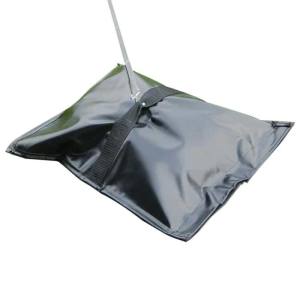
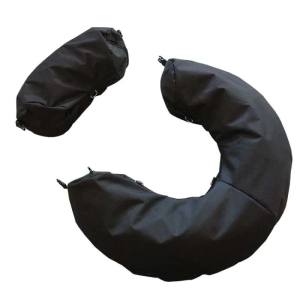
Ballast comes in various forms. Cast iron or concrete discs and blocks slide over the leg and are ready to use straight away. Fillable plastic weights are filled on site with water or sand, which keeps transport light but requires filling on the spot. Ballast feet or base plates combine stability with a flat foot that does not stick out into the walkway. On grass you use pegs with guy lines, in a length and thickness that suits the ground.
Material and technique
Weights are made of cast iron, concrete, steel or fillable plastic. Metal is compact and immediately usable; plastic is lighter to transport but needs water or sand on site. Ratchet straps are made of polyester with a buckle closure and have a stated load rating: do not use luggage straps for structural work. Pegs come in different profiles, because a stake that works in firm ground holds nothing in soft meadow soil.
Practice, wind and liability
The amount of ballast depends on the tent area, the height, the ground and whether the side walls are open or closed. A closed tent catches the wind like a balloon and needs considerably more ballast than an open one. Spread the weight over all the legs, not just the two you happen to reach, and fix the ballast to the leg instead of setting it down beside it.
This is not a detail but a safety matter. A tent that lifts off is a frame of sharp tubes rolling across a site. As the organiser you are liable for the damage and injury that follow. Agree in advance who decides to dismantle when wind is forecast, and make sure there are enough people to do it quickly.
Maintenance and storage
Rinse weights after use on sand or mud and store them in a trolley, so you do not have to carry them one by one. Empty fillable weights before winter to avoid frost damage.
When this is not enough
For a tent structure that stays up for weeks, or for large spans, loose ballast is not sufficient and you need a calculated anchoring. On sloping or soft ground you also run into the limits. The classic mistake is choosing ballast on the basis of what is easy to carry instead of what the tent area demands.
What determines the price?
The price follows from the type of ballast and the weight per unit, the material, the version and finish, the number of units, and the accompanying ratchet straps, pegs, connectors or gutters. A transport trolley or storage crate and the delivery also play a part. Give us the tent size and the ground, and we will work out how much ballast you actually need.
Prices are available in the Herva-Doublet Platform.
Putting your tent up safely together
Tell us which tents you work with and on what ground they stand. We will propose a set of ballast and accessories that matches your equipment. Get in touch for advice and a quotation.
Projects
All projects
Didn't find what you were looking for?
What you see here is a selection. Our range is considerably wider — in sizes, materials and finishes that we cannot all show online. Tell us what you need it for and where it has to go, and we will work out what fits.
Ask your questionAccess to prices and ordering
Request access to our Herva-Doublet Platform. Sign up in two minutes, confirm your e-mail address and see all prices right away.