
Bollards and anti-parking posts
Closing and marking bollards to steer or block traffic. Fixed or folding, in finishes that suit the streetscape.
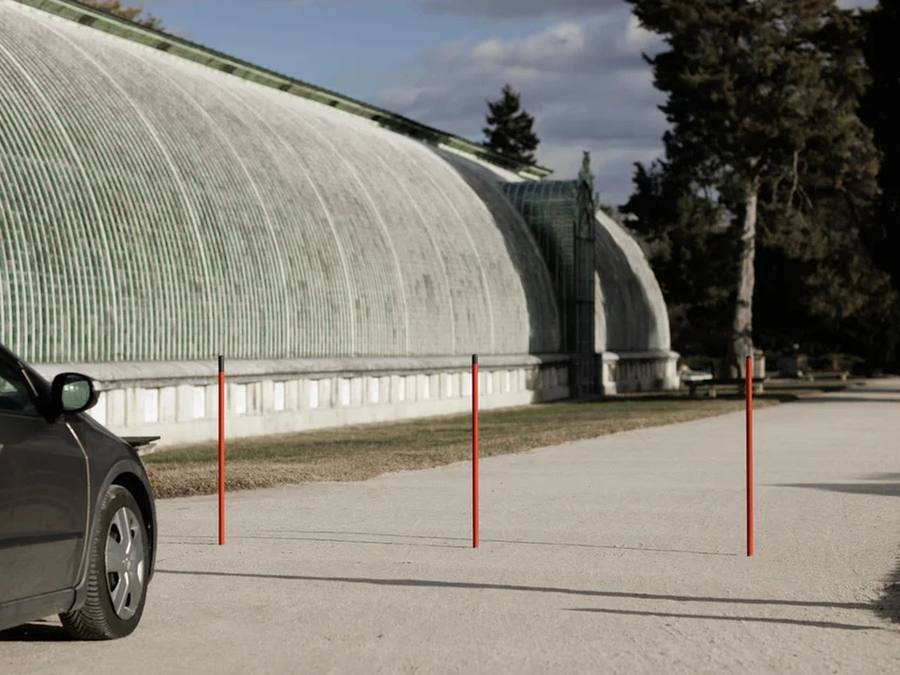
All bollards and anti-parking posts
Prices are available in the Herva-Doublet Platform.
Fixed bollard Carrefour
Fixed bollard Province Ø 76/114 mm
Lockable ground sleeve (removable)
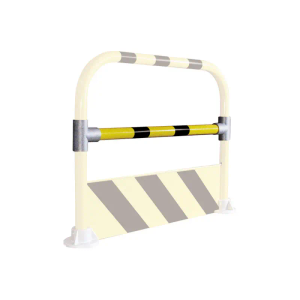
Reinforcement tube with aluminium connectors
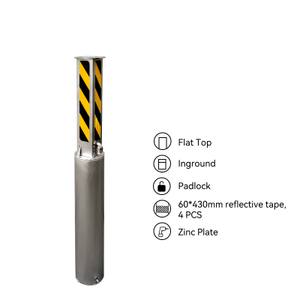
Retractable bollard Ø 100 mm with padlock
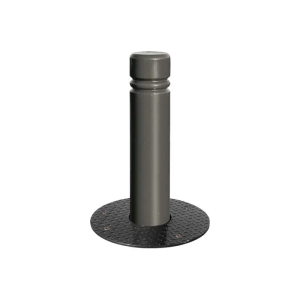
Retractable decorative bollard
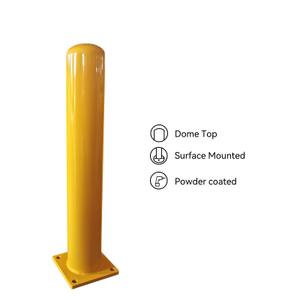
Heavy-duty bollard on base plate with domed top
- Our approach
- 1Concept definition
- 23D design
- 3Production
- 4Installation
- 5Maintenance
What this gives you
From first sketch to maintenance — one partner who coordinates the whole project.
One partner, from A to Z
You call one number. We measure, design, have it produced, install and maintain. No fragmented responsibility, no waiting on subcontractors pointing at each other.
You see it before it exists
A 3D visualisation of your own façade or space, by day and by night. Production only starts once that image is right. No surprises afterwards.
Everything under one roof
From façade to interior: 20 product families with one partner. No need to coordinate three suppliers.
Built to last
ISO 9001 and ISO 14001. Colourfast, weather-resistant materials and energy-efficient LED lighting. With long-term service and maintenance.
Bollards and anti-parking posts for the public realm
Bollards and street posts are what you use to guide, block or mark off traffic without installing a full barrier. They keep cars off a footpath, a square or a cycle link, they protect a facade or a terrace, and they mark the line between where you drive and where you walk. Because they stand in full view, they also determine how well kept a public space looks.
Buyers are municipalities and cities, road authorities, developers and companies with their own site or car park. We supply both the plain, functional versions and posts that suit a historic centre or a redesigned square, and we think along with you about where a fixed post belongs and where a folding or removable version is needed.
Applications
- Keeping footpaths and squares free of parked vehicles
- Closing cycle links and cycle streets to motorised traffic
- Controlling access to a pedestrian shopping area outside delivery hours
- Protecting facades, corners, loading bays and service cabinets against impact
- Marking out terraces, planted areas and play zones
Versions
Fixed posts are set in concrete or anchored on a base plate and are the simplest and strongest solution wherever no vehicle should ever pass. Folding posts tilt to the ground with a lock and are the standard at entrances that only need to open for emergency services, suppliers or maintenance teams. Removable posts are lifted out of a ground socket with a key and stored away, which is convenient for markets and events.
Material and finish
The usual materials are hot-dip galvanised steel, powder-coated steel, cast iron, stainless steel and timber. Galvanised and powder-coated steel is the workhorse: low maintenance and available in any colour. Cast iron is chosen in historic centres for its profile and decorative heads. Stainless steel gives a clean, modern look but needs regular cleaning to prevent staining. Timber suits parks and green zones but has a shorter service life.
Reflective bands or strips are worth specifying on every post that stands near moving traffic in the dark. It is a small detail with a large effect on safety.
Installation and practice
The spacing between posts decides whether they do what you want. Too wide and a car still squeezes through; too narrow and a wheelchair, a pram or a cargo bike cannot get past. So set the spacing from the users who do need to pass. Keep blind and partially sighted people in mind as well: a low post in the middle of a walking line is a trip hazard unless it contrasts strongly and can be detected with a cane.
When posts are not the right answer
If you want to make a zone completely inaccessible to vehicles of any size, a fence, a gate or a retractable bollard is the better choice. Where vehicles manoeuvre regularly and impacts are unavoidable, a flexible post or an impact barrier makes more sense than a rigid post that has to be replaced every time. The classic mistake is installing posts to solve a behavioural problem without measuring the clearance left for pedestrians and cyclists.
What determines the price?
The price follows from the material and diameter, the height, the version - fixed, folding or removable -, the finish and colour, decorative elements and reflection, the locking, the fixing method and the matching ground sockets or base plates. Quantity plays a part, as do transport and any installation. Tell us the situation and the number of posts, and we will put a concrete proposal together.
Prices are available in the Herva-Doublet Platform.
Looking at your streetscape together
Tell us what you want to keep out and what still has to get through. We will propose a post type, a spacing and a finish that suits the location. Get in touch for advice and a quotation.
Projects
All projects
Didn't find what you were looking for?
What you see here is a selection. Our range is considerably wider — in sizes, materials and finishes that we cannot all show online. Tell us what you need it for and where it has to go, and we will work out what fits.
Ask your questionAccess to prices and ordering
Request access to our Herva-Doublet Platform. Sign up in two minutes, confirm your e-mail address and see all prices right away.