
Traffic signs
Traffic signs compliant with the applicable standards for dimensions, retroreflection and installation. With the technical data sheets your file needs.
Our approach
- 1Concept definition
Experts determine what works best for your project.
- 23D design
Realistic visualisations on your own site for approval.
- 3Production
Your design is made to measure.
- 4Installation
Expert installation on site.
- 5Maintenance
Long-term service and maintenance.
What this gives you
From first sketch to maintenance — one partner who coordinates the whole project.
One partner, from A to Z
You call one number. We measure, design, have it produced, install and maintain. No fragmented responsibility, no waiting on subcontractors pointing at each other.
You see it before it exists
A 3D visualisation of your own façade or space, by day and by night. Production only starts once that image is right. No surprises afterwards.
Everything under one roof
From façade to interior: 20 product families with one partner. No need to coordinate three suppliers.
Built to last
ISO 9001 and ISO 14001. Colourfast, weather-resistant materials and energy-efficient LED lighting. With long-term service and maintenance.
Road signs for private sites and the public domain
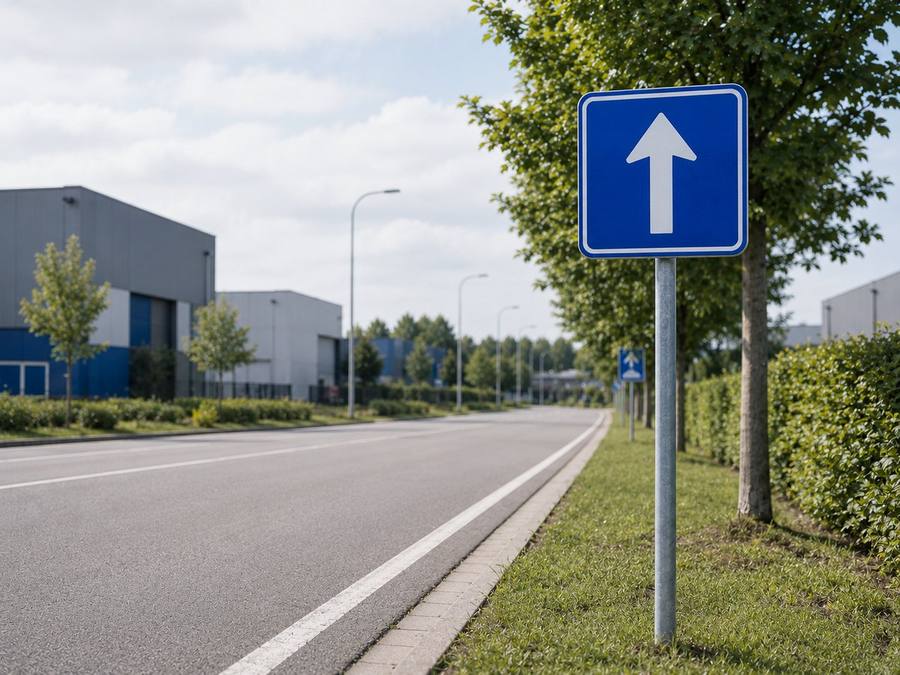
Road signs govern who may drive where, how fast and in which direction. On the public road the design is tightly regulated; on a company site, a car park or a school environment you have more freedom, but the same principle applies: a sign only works if it is recognised without thinking.
We supply road signs to local authorities, contractors, companies, schools and the managers of sites and car parks. From a single sign to the complete signage of a newly laid out zone, including posts, brackets and installation.
The categories and what they mean
- Mandatory signs: round and blue, they prescribe what you must do, such as compulsory direction of travel, cycle path or footpath.
- Prohibitory signs: round with a red border, they forbid, such as no entry, no parking or a speed limit.
- Warning signs: triangular with a red border, they warn of a narrowing, cyclists crossing or a dangerous bend.
- Priority signs: they set out who goes first.
- Information signs: rectangular and blue, they inform about parking, a 30 km/h zone or a dead end.
On private sites we use the same visual language. A sign of your own invention loses its force, because drivers react to what they recognise from the Belgian highway code.
Retroreflection: the class determines the visibility
The difference between a sign that lights up in your headlights at night and a sign that stays dull lies in the reflective film. There are several classes, from a basic version to high-performance film that stays legible under side lighting and in the rain.
The choice depends on the location. A sign along a lit car park can be produced in a lighter class; a sign along a dark regional road or at an exit where lorries pass at night deserves the highest class. We advise per situation and state the class explicitly on the quotation, so that you know what you are buying. Tender specifications usually prescribe the class; we check against them.
Size and reading distance
The dimensions follow from the speed at the location. The faster the traffic, the earlier the sign has to be read and the larger it therefore has to be. On the public road the sizes are fixed by standards. On a private site we choose the size on the basis of the actual approach speed and the sightline.
A common mistake is a sign that is too small on a post that is too high, or a sign that disappears behind a shrub after two summers. When surveying, we therefore look at the sightline as it will be in a few years, not only as it is today.
Material and mounting
The standard is an aluminium plate with a reinforced edge, finished with reflective film. Aluminium does not rust, stays flat and lasts decades. For temporary signage at works there are lighter versions in plastic or on a movable base.
Mounting is on a galvanised post, on an existing post with brackets, or against a facade or fencing. The foundation depends on the substrate and on the wind load on the sign face: a large sign on a high post needs noticeably more than a small one. We calculate that rather than estimate it.
What is often forgotten
- A sign imposing a rule that nobody enforces undermines every other sign on the site. Better to place fewer signs and make sure they are right.
- On a private site a road sign is only enforceable once it is tied to a set of rules made known to visitors, for instance with an information board at the entrance.
- For works on or beside the public road, separate rules apply to temporary signage, with their own requirements for colour, placement and lighting.
- Damaged or faded signs are better replaced completely than partially: a sign whose film has gone dull no longer reflects and gives a false sense of safety.
What determines the price?
There is no fixed price per road sign. The cost follows from the size, the class of reflective film, whether it is a standard sign or a bespoke one, the number of pieces (with a series of identical signs the cost per piece drops sharply), the posts and brackets, the foundation that follows from the substrate, and the installation conditions, such as working alongside a busy road or outside peak hours.
Send us your plan or a list of signs and locations, and you get a quotation in which every item is visible separately, together with the technical data sheets your file requires.
Prices are available in the Herva-Doublet Platform.
Submitting your situation
Send us the site plan or a few photos of the location. We will indicate which signs are needed, in which class, and where they are best placed.
Projects
All projects
Which traffic signs are used in Belgium?
The Belgian highway code groups traffic signs by function. Warning signs (A) alert drivers to a hazard, priority signs (B) set who goes first, prohibition signs (C) ban a manoeuvre or access, mandatory signs (D) impose an obligation, stopping and parking signs (E) regulate parking and information signs (F) give directions and information. Municipalities use them on public roads, contractors at roadworks and building sites, companies on their own premises and car parks. We work out with you which signs are needed, supply them with post and fixings and install them with our own teams.
Further reading
Read what is legally required in terms of safety signage in the workplace.
Didn't find what you were looking for?
What you see here is a selection. Our range is considerably wider — in sizes, materials and finishes that we cannot all show online. Tell us what you need it for and where it has to go, and we will work out what fits.
Ask your questionReady to start your traffic signs project?
We think along from the first sketch through to installation and maintenance.