Expanded metal
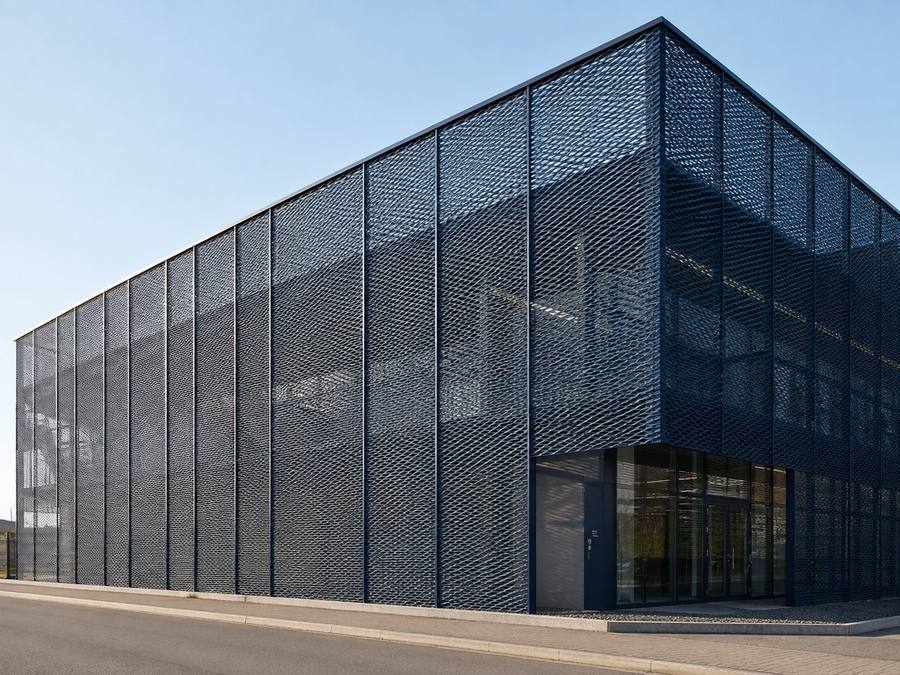
Stretched and perforated metal with an industrial, semi-transparent look. Doubles as solar shading or screening — ideal for car park volumes and technical façades.
Our approach
- 1Concept definition
Experts determine what works best for your project.
- 23D design
Realistic visualisations on your own site for approval.
- 3Production
Your design is made to measure.
- 4Installation
Expert installation on site.
- 5Maintenance
Long-term service and maintenance.
What this gives you
From first sketch to maintenance — one partner who coordinates the whole project.
One partner, from A to Z
You call one number. We measure, design, have it produced, install and maintain. No fragmented responsibility, no waiting on subcontractors pointing at each other.
You see it before it exists
A 3D visualisation of your own façade or space, by day and by night. Production only starts once that image is right. No surprises afterwards.
Everything under one roof
From façade to interior: 20 product families with one partner. No need to coordinate three suppliers.
Built to last
ISO 9001 and ISO 14001. Colourfast, weather-resistant materials and energy-efficient LED lighting. With long-term service and maintenance.
Expanded metal: half open, half closed
Expanded metal is made by slitting a metal sheet and then stretching it. No material is lost — the sheet grows larger and takes on a regular diamond pattern. That makes it light and strong at the same time, and gives the material its characteristic semi-transparent look: from close up you see through it, from a distance or at an angle it reads as closed.
We use expanded metal in façade cladding, solar shading, screening, balustrades and interior elements, for industrial buildings, car parks, schools, showrooms and public buildings.
Why architects and estate managers choose it
Expanded metal usually does several things at once, and that is the heart of its appeal.
It screens without becoming a blank wall. A car park or a plant room can be wrapped completely while light and air still pass through and there is still a view from inside. It works as solar shading: depending on the mesh shape and the angle of installation it holds back a considerable share of the direct sun without taking away daylight. And it gives a building an industrial, contemporary look that ages well.
On top of that, the material ventilates itself. Heat does not build up behind an expanded metal skin the way it does behind a closed panel.
What the mesh shape determines
The mesh shape and the open area govern the entire appearance.
- A small mesh already reads as fairly closed from close up and gives the most privacy and solar shading.
- A large mesh lets more light and view through and looks airier.
- The angle at which the strands sit determines how the material plays with the incoming light. Set vertically, you see through it from below and not from above, or the other way round. That is a design decision, not a detail.
We prefer to show those differences with samples in daylight, because on a drawing or a screen expanded metal always looks different from reality.
Material and finish
Hot-dip galvanised steel is the robust standard, powder-coated afterwards in any RAL colour. Aluminium is lighter and does not corrode, which makes it the choice for large façade areas and coastal locations. Stainless steel is used where there is chemical loading or a high aesthetic demand. Corten steel forms a stable rust layer with a warm colour.
One point matters with powder-coated expanded metal: the coating has to penetrate properly onto the cut edges inside the mesh as well, otherwise corrosion starts there. That is why we work with suppliers who coat after expanding, not before.
Construction and installation
Expanded metal is rarely used loose. It comes in panels or cassettes with a surrounding frame, mounted on a sub-structure. That frame is what makes the result crisp: without one, a large sheet ripples.
Points we take into account in advance: the wind load on large areas, the thermal expansion of long panels, access for maintenance behind the skin, and the junctions around windows, corners and the roof edge. With balustrades, fall protection is added to that, which can limit the mesh size.
Maintenance
Little. Periodic cleaning keeps the appearance even, which is needed more often along busy roads because dirt settles in the mesh. Touching up damaged coating prevents corrosion. Panels can be removed individually, so local damage does not mean full replacement.
What determines the price?
Expanded metal has no fixed price per square metre. The cost follows from the base material — steel, aluminium, stainless steel or corten —, the sheet thickness and the mesh shape, the finish and the coating class, the panel dimensions and the number of different sizes, the framing and the sub-structure, the working height and the lifting equipment required, and special requirements such as fall protection or reaction to fire.
Send us the façade drawings or the dimensions with a few photos, and you will receive a quotation in which the panel, the frame and the installation are set out separately.
Prices are available in the Herva-Doublet Platform.
Putting your project to us
Send us the drawings or the look you are after. We will come to site, take measurements and show you samples in daylight before anything is produced.
Projects
All projects
Didn't find what you were looking for?
What you see here is a selection. Our range is considerably wider — in sizes, materials and finishes that we cannot all show online. Tell us what you need it for and where it has to go, and we will work out what fits.
Ask your questionReady to start your expanded metal project?
We think along from the first sketch through to installation and maintenance.