
Ben Saenen
10+ years in illuminated signage, façade cladding and wayfinding
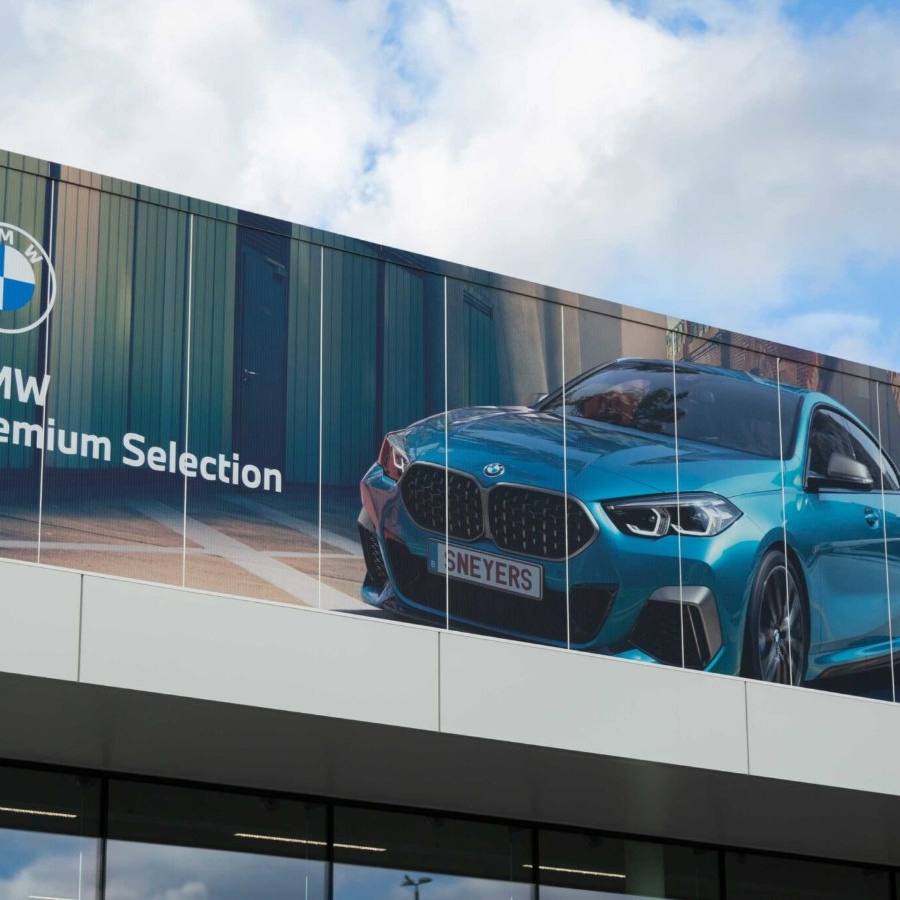
Not every façade calls for light. A crisply printed dibond panel, routed letters or a wooden board often do exactly what is needed: make clear who is based here, neatly and for years. We produce and install non-illuminated façade signage in all common panel materials.
Experts determine what works best for your project.
Realistic visualisations on your own site for approval.
Your design is made to measure.
Expert installation on site.
Long-term service and maintenance.
From first sketch to maintenance — one partner who coordinates the whole project.
You call one number. We measure, design, have it produced, install and maintain. No fragmented responsibility, no waiting on subcontractors pointing at each other.
A 3D visualisation of your own façade or space, by day and by night. Production only starts once that image is right. No surprises afterwards.
From façade to interior: 20 product families with one partner. No need to coordinate three suppliers.
ISO 9001 and ISO 14001. Colourfast, weather-resistant materials and energy-efficient LED lighting. With long-term service and maintenance.
Not every façade needs to be lit. A well-made panel, a set of cut letters or a wooden sign do their job perfectly in daylight — and they call for less permitting, less maintenance and less investment than an illuminated solution.
Here the choice of material determines everything: the appearance, the lifespan and the price. So that is where we start.
An aluminium composite panel: strong, perfectly flat and colourfast for years. The most common material for façade panels, and the standard choice when the sign still has to look good in five years' time.
A lighter plastic sheet, more economical than dibond. Suitable for applications under less load and where a shorter lifespan is acceptable.
Light and economical, with a hollow chambered structure. Often used for temporary communication or for larger surfaces where weight matters.
A recyclable cardboard sheet with a honeycomb core. The sustainable choice for indoor use and temporary communication, and fully recyclable with waste paper afterwards.
All these materials are either printed directly or lettered with cut vinyl. Both are finished with a protective laminate, and that laminate matters more than most people assume: it largely determines how long your colours stay right.
A south-facing sign with no shelter fades noticeably faster without proper protection than the same sign under a canopy. We select the laminate according to orientation and expected lifespan, and we say so when a cheaper build-up is a poor investment at your location.
Cut letters are individual letters, routed from sheet material and mounted separately on the façade. They give a high-quality, three-dimensional impression without using a single lamp — the effect of built-up letters at a lower cost.
Wooden signage suits a natural or rural setting: estates, walking routes, farms, garden centres. Where aluminium feels too technical, wood does exactly what is needed.
For façade signage the price varies with four things: material, size, finish and installation. A dibond panel with a long-life laminate costs a multiple of the same size in fluted board, and that gap is justified — it also lasts a multiple longer.
Size does not scale linearly. Sheets come in standard dimensions, and a sign just wider than one sheet requires either a joint or a larger sheet, with offcuts as a result. A few centimetres less can therefore make a noticeable difference; we point it out when that is the case.
Finally, installation: working height, substrate and access. A sign at eye level on brickwork is a different matter from the same sign seven metres up on an insulated façade.
Prices are available in the Herva-Doublet Platform.
For unlit façade signage a permit is often simpler than for an illuminated one, but simpler is not the same as unnecessary. Virtually every municipality has rules on dimensions, positioning and sometimes even colour, and in protected townscapes or shopping streets these can be strict.
Always check your municipality's rules before having anything produced. We supply the drawings and material specifications that go with an application.
We survey, produce a 3D design of your own façade, manufacture and install. Send us a photo and your logo, and you will see the result before anything is made.
Read when a advertising totem is the better choice than facade signage.
10+ years in illuminated signage, façade cladding and wayfinding
Direct contact runs through our team: 014 55 69 22 or info@herva.be.
We think along from the first sketch through to installation and maintenance.