
How many bicycle parking spaces should a new-build project provide?
How many bicycle spaces are required in a new build, how to calculate them, and why a shelter that meets the standard can still stay empty.
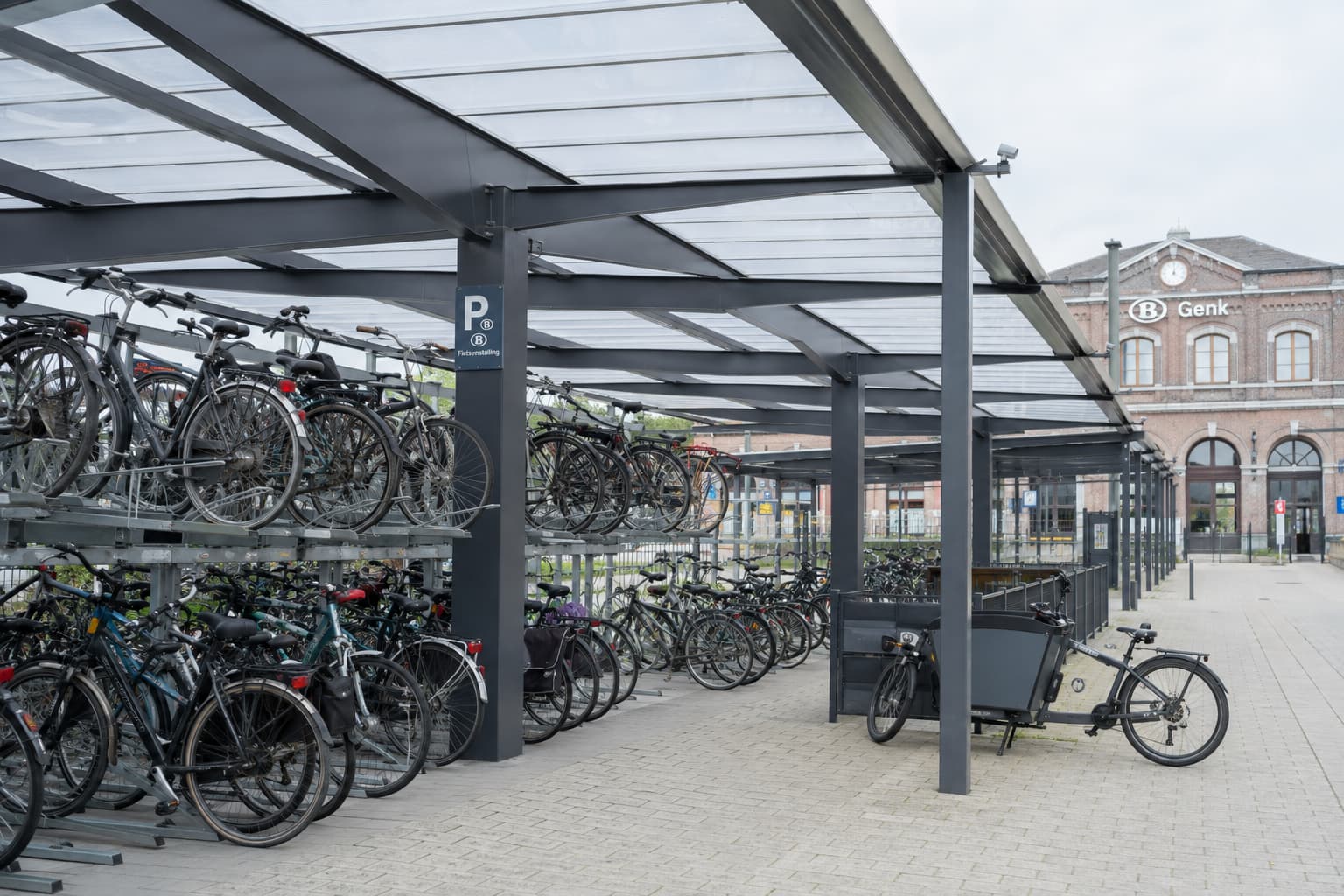
It is almost always the same question, and it almost always comes too late. The design is fixed, the environmental permit application is being prepared, and then someone stumbles over the bicycle storage: how many spaces do we actually need? By then there is only one corner left where it fits, and that corner determines everything else.
The awkward part is that no single number is right everywhere. The good news is that the logic behind it is the same everywhere, and that you can work it out in half a day if you know where to look.
The number is in the municipal regulation
Flanders imposes no general bicycle parking standard for private new builds. That standard is set in the municipal planning regulation of the municipality where you build, and it varies. Some municipalities count per dwelling unit, others per bedroom, others per square metre of gross floor area for offices and retail. The first step in any file is therefore not to calculate, but to request the parking regulation of that specific municipality. Where there is no regulation, the permitting authority often imposes a standard anyway during the assessment.
A concrete example: the Antwerp building code
The building code of the city of Antwerp is one of the most detailed regulations and gives a good sense of the order of magnitude. For dwellings it requires one space per bedroom, plus one extra space per dwelling. For student rooms, one space per room. For offices, 1.25 spaces per 100 square metres of gross floor area; for retail, hospitality and services, 0.60 per 100 square metres, plus two visitor spaces per 100 square metres of publicly accessible space. For schools it rises further: nine spaces per class in primary education and twenty per 100 square metres in secondary.
Work that out for an apartment building with twelve units of two bedrooms on average and you already reach thirty-six spaces. That is no longer a storage room, it is a design decision.
What the regulation does not say
Regulations count in spaces; users count in the bicycles they actually own. A standard rarely accounts for the share of cargo bikes, longer e-bikes and bikes with a child seat, and those are exactly the ones that take up space. Many regulations assume roughly one and a half square metres per bike including circulation, and that is an average: a cargo bike does not fit within it. So deliberately provide a share of wider and longer spaces rather than placing the same rack everywhere. A shelter that meets the standard on paper but that half the residents cannot use is a shelter that stays empty.
Accessibility decides whether the shelter gets used
This is where things go wrong in practice. Bicycle storage on the ground floor next to the entrance gets used. Storage at the back, behind two doors or at the bottom of a staircase does not, and the bikes end up in the entrance hall anyway. If the shelter goes underground, you need a ramp, a staircase with a wheel channel or a lift; as a rule of thumb a ramp should not exceed about twelve percent and a stair channel no more than twenty. Also keep bicycle access physically separate from car access. These choices cost almost nothing at design stage and almost everything afterwards.
Covered and lockable is often a requirement, not a choice
Many regulations require the spaces to be in a separate, covered and locked room. Even where that is not mandatory, it is usually the wisest choice in a new build: bikes stay there a long time, they are expensive bikes, and dry storage extends the life of both the bike and the system. For projects where not everyone can use the same room, individual bike boxes and lockers are a workable alternative, especially for cargo bikes and for residents who leave their bike unused for months.
Charging points for e-bikes
More and more regulations require at least one charging point above a certain number of spaces, and if the spaces are spread over several rooms, that applies per room. Even without that obligation, it is wise to provide the conduits now: running a power supply to a locked storage room afterwards costs many times what it costs during the shell construction. Also consider fire safety and proper separation of circuits.
The three mistakes we see most often
The first: calculating only at the end, so the shelter gets the leftover space. The second: just meeting the standard without checking who actually parks there, leaving too little room for non-standard bikes. The third: placing racks too close together to reach the number. A space where you cannot get your bike in or out without moving your neighbour's handlebars counts in the file, but not in practice.
What determines the price
There is no fixed price per space, and anyone who gives one is leaving something out. The type of system, the capacity, the construction and finish, the ground and foundations, the locking and access system and the accessibility of the site together determine the cost. Two projects with the same number of spaces can therefore be far apart. That is why we calculate per project. You will find the specific amounts per product on the Herva-Doublet Platform: create a free account and you immediately see all prices, including installation.
Starting early costs nothing
The best files are those where the bicycle shelter is already on the plan at the preliminary design stage, with the right area, in the right place and with a system that suits the people who will park there. We measure in advance, calculate the capacity and deliver a layout that meets the regulation and actually gets used. Feel free to send us the plan at an early stage — that way you say it once now, instead of fixing it later.
Frequently asked questions
Further reading
Related articles
Ready to take the next step?
Request more information, or create a free account in the Herva-Doublet Platform and see all prices right away.